Track the hours of the people you employ, pay them correctly, and walk into tax season with every form ready — every number cited to its IRS source. Designed so doing the right thing is the easiest path, for both of you.
Whether you employ a nanny, eldercare aide, gardener, tutor, housekeeper, or handyman, they get their own free app and you get one calm dashboard.
Household payroll runs on different rules than a business: FICA doesn't apply to a worker until you've paid them $3,000 in a year (2026 IRS threshold), and the paperwork files once a year with your personal Form 1040 — never quarterly.
We're not another payroll tool with "household" in the marketing copy. The shape of the data + the shape of the screens is built for this kind of work specifically.
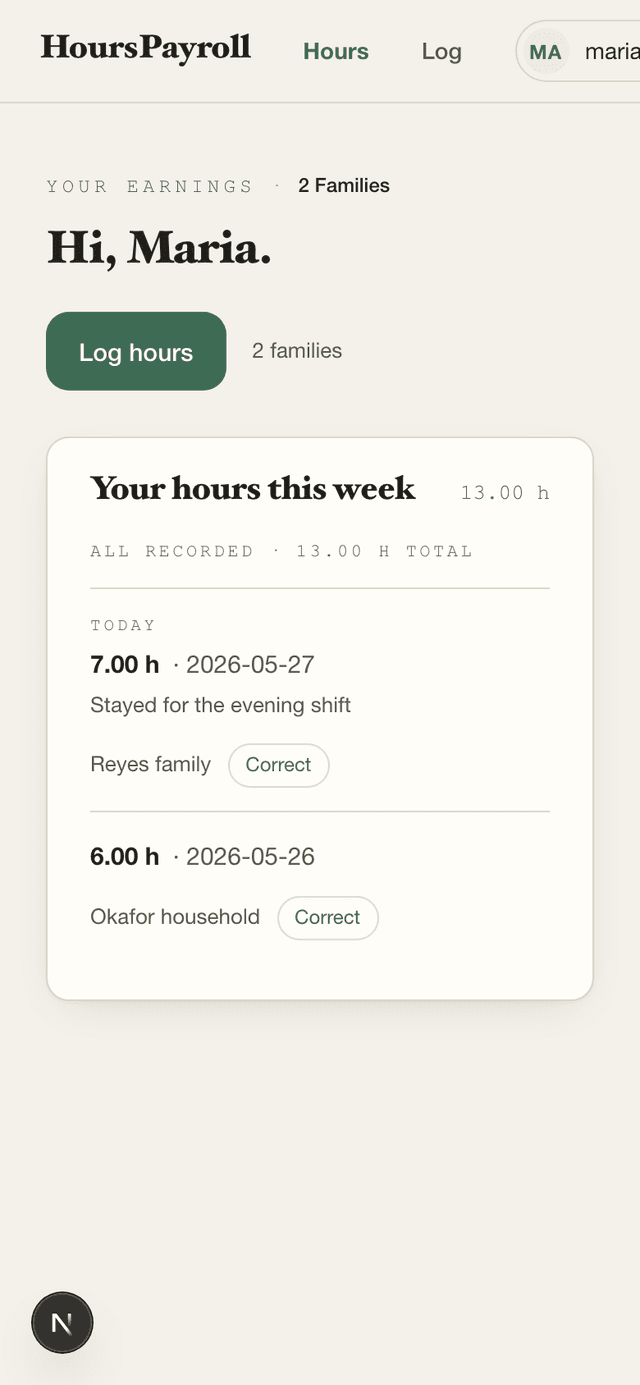
Your employee tracks their own time in three taps. If they fix something, both of you see the correction, no more "you said 30, I have 28" at the end of the week.
Every number is labeled. "Estimated" until you approve. "Paid" only when the money has actually moved into their account. No suspense.
We know when banks are open, when payday should land, and how many business days back to nudge you. Calm reminders. Never alarm-red.
Their hours, pay history, and W-2s travel with them across every family they work for. None of you ever see each other's data. That's enforced on every request at the API layer, not just hidden in the screen.
Most payroll software wants your bank account and a mandate to file on your behalf. We started from the other end: get every number provably right, keep records that hold up, and hand you the exact forms. Your money keeps moving the way it does now — from you.
Flat, transparent. The same number every month, no per-employee creep.
Everything we have today: hours tracking, cited pay math, your employee's app, pay stubs, year-end forms (W-2, 1099-NEC, Schedule H), and the CPA packet. You handle the actual paycheck the way you do now.
Sign up free →Numbaroll never moves your money and never files for you — that's the point. You stay in control; we make sure every number is right, cited to its IRS source, and that the exact forms are in your hands at tax time.
Start free, keep your records →Shipping in public is the only honest way to build a payroll product. Here's exactly where we are.
Schedule H, not Form 941.Household payroll files annually with the employer's personal Form 1040, due the same April 15 deadline (or your extension date) — not quarterly like a business. The $3,000 FICA cash-wage threshold for 2026 (up from $2,800 in 2025) applies; we flag it inline in the dashboard. Worker forms (W-2, 1099-NEC) go out by January 31 each year.
Authorization, the right way.We capture either Form 8655 (reporting-agent designation) or Form 2678 (employer-of-record), depending on the household's arrangement. The plain-language acknowledgment makes it clear that signing doesn't shift the employer's responsibility.
Live-in OT & multi-state. Our overtime engine reads work_state + live_in per employment, so the 10-state live-in exception is data, not hardcode. Multi-state worker registrations track per employment, not per employer.
We prepare; your client files. Numbaroll never files with the IRS or a state agency, and never moves wages. Every form we generate says so. If we ever integrate a payments or filing partner, it will be opt-in and named on this page before anything moves. No silent decisions.
It's actually different. When you employ a household worker, nanny, eldercare aide, housekeeper, gardener, tutor, or anyone else, the IRS treats it as real employment, but you file the taxes on YOUR personal return (Schedule H), once a year, not quarterly like a business. Generic payroll software either doesn't handle this or forces you through the business path and overcharges. We built around the household case specifically.
Set up your household, invite your employee, track their hours, generate pay stubs with estimated taxes, keep all their records for 3+ years, and prepare your Schedule H worksheet so you (or your accountant) can file. You'll still write their checks the way you do today, but you'll have the paperwork done right.
Not as a core feature — on purpose. Services that move your money and file in your name are also the ones whose mistakes become YOUR penalties. Our job is to make every number provably right (each line cites its IRS source) and put the exact forms in your hands. If we ever add direct deposit, it will be through a licensed, named partner, opt-in, never required.
Yes for any worker you put on the books, nanny, eldercare aide, housekeeper, gardener, tutor, handyman, doula. The shape of household payroll is the same regardless of what they do; it's a Schedule-H filing on your personal return. If you have a mix of on-the-books and informal arrangements, we just give you correct records for the on-the-books help without lecturing you about the rest.
Nothing right now, while we're in beta. When billing starts it's $30/month per household, flat — no per-employee add-ons that quietly grow your bill, and we'll email you before your first charge. Your records and forms stay yours either way.
No, and this is enforced on every request at the API layer, not just hidden in the screen. Your employee can see all their hours and pay across every family they work for, in their own private view. None of you ever see each other.
No. Each family sees only the hours and pay you logged for them. Your unified earnings view, every family, every paycheck, your YTD, is yours alone. The families never see each other and never see your other employers' names.
That's on our short list. Right now we treat the day you sign up as day one. CSV import is coming.
Free while we're in beta. Set up your household, add your worker, and run your first cited payroll in minutes. No card required.